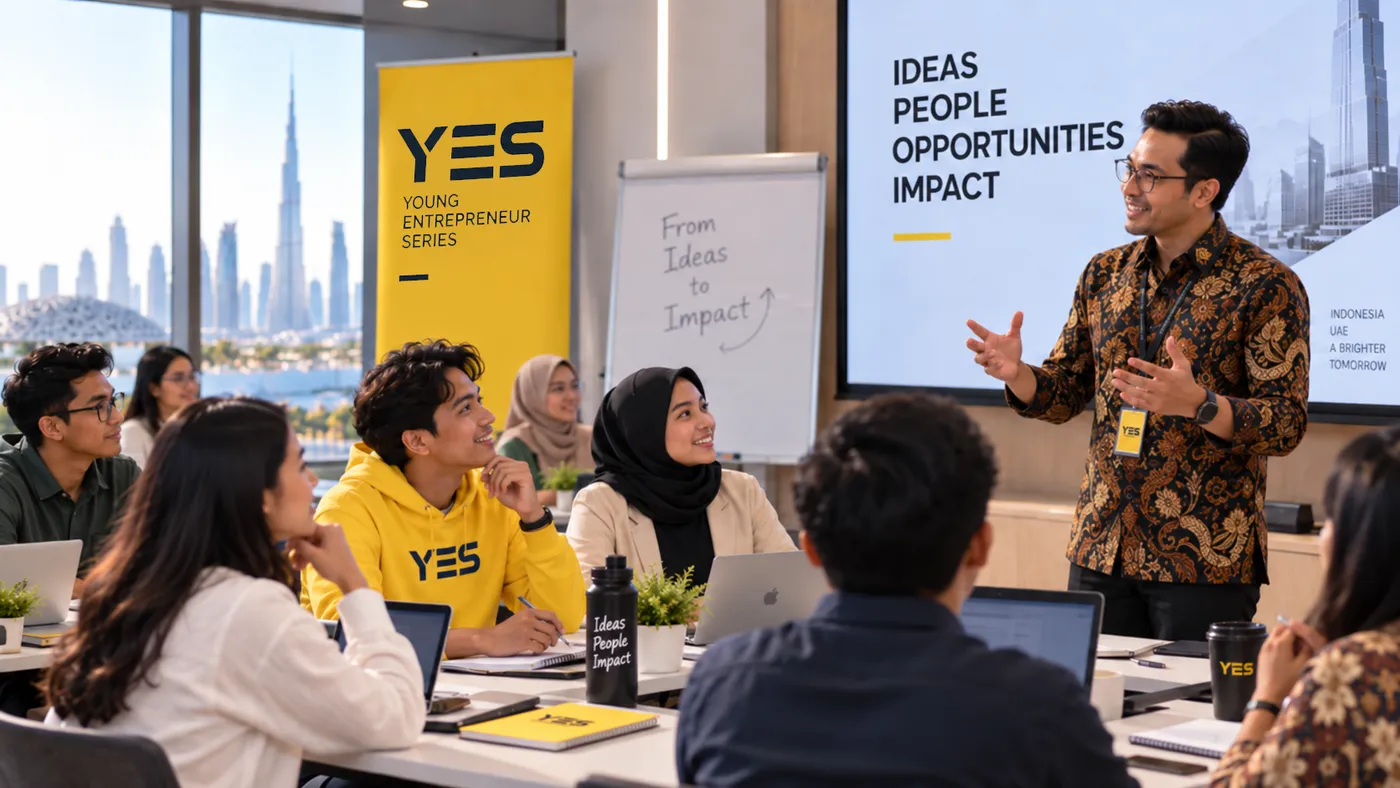
YES runs from 9 September 2026 to 31 January 2027. Everything you do in the Academy feeds the proposal you submit, and the proposal is what carries you through the Semi-Final to the Grand Final.
YES Academy · Learn & Build
Every session ends with something you can put in your proposal.
Six sessions of two hours each. The Academy is not a lecture series running alongside a competition — it is the competition's first half. Each session produces one specific part of your YES Business Proposal.
Communicate your opportunity clearly and credibly — to judges and to investors.
Proposal outputYES Pitch Deck + Final Proposal
What a session looks like
Concept or framework, a case study, a practical AI application, an exercise you do yourself, Q&A, and a proposal assignment to take away.
Every session runs online, so you can join from wherever you are, at the same time each week. Each date is on its session card below.
12:00–14:00 UAE time15:00–17:00 WIB (Jakarta)
Practical AI
AI runs across all six sessions, not as a seventh one.
AI is a layer through the Academy rather than a module bolted on the end. You learn where it genuinely helps, and where your own judgement has to do the work.
Customer & market
Persona exploration, market research, competitor mapping.
Business model
Idea refinement and stress-testing the model you've built.
Finance
Scenario analysis and testing the assumptions underneath your numbers.
Marketing
Content development and campaign ideation.
Pitch
Improving the presentation, and rehearsing the delivery.
And the limit
You stay responsible for accuracy, originality and confidentiality. You must be able to explain and defend everything you submit.
The business proposal
One document, built across five months.
You submit one proposal on the official YES template. It is your own work, and it should follow one habit throughout: claim, evidence, metric.
What it covers
Entrepreneur or team, and business profile
Problem or opportunity, and your customer
Product or solution
Market, competition and value proposition
Business model and go-to-market
Traction and business performance
Financial overview
Sustainability, impact and growth plan
Support required, and why you
How submission works
You submit through your dashboard on this site: your proposal file, up to five supporting documents, and a link to a pitch video if you made one.
You can replace your proposal as often as you need before the deadline. Each submission is stored as a complete version, with the previous one kept underneath it. Supporting documents carry over automatically.
Worth knowing: a new version voids the committee's previous completeness check, so send the version you mean to send.
How you're judged
Three gates, and they don't ask the same question.
Eligibility is a gate, not a score. Quality is only assessed once eligibility is confirmed. After that, each stage looks for different evidence.
Gate 1A · pass / fail
Eligibility & completeness
A non-scored administrative check. Can this entry proceed?
Age eligibility
Geographic eligibility
Individual or team requirement
Registration completed
Proposal submitted on time
Required sections complete
Originality declaration completed
Gate 1B · scored
Proposal revision
Is the business case strong after the Academy?
Problem and market relevance
Product, solution and differentiation
Business model and commercial viability
Traction and validation
Growth potential
Sustainability and impact
Proposal quality and clarity
Gate 2 · scored
Semi-Final
Can you defend what you wrote? You present in front of a panel of judges, then take questions.
Problem and market understanding
Solution and competitive advantage
Business model and commercial viability
Traction and evidence
Growth and scalability
Founder or team capability
Pitch and Q&A
Gate 3 · scored
Grand Final
Who has the strongest overall potential? A final pitch in front of the panel of judges.
Business opportunity
Innovation and competitive advantage
Commercial viability
Growth and scalability
Entrepreneur or team capability
Sustainability and impact
Final pitch and Q&A
YES is not a pitch competition
Judges assess the entrepreneur and the business, not presentation skill. Communicating clearly matters, but so do market opportunity, business model, evidence, traction, financial viability, growth potential, impact and your capability to execute. Business substance beats presentation theatrics.
Judges score independently before any panel discussion, using the same rubric and a 1–5 scale. Conflicted judges abstain.
Key dates
September to January, end to end.
Exact dates are published here as they are confirmed, and announced through the official YES channels. This site is the single source of truth for dates and rules.